
Last Updated on March 24, 2026 by Denis Yankovsky
Images & video: courtesy of Semrush
Table of Contents
Key Takeaways
- Overall Verdict: Semrush remains a top-tier all-in-one SEO and digital marketing platform worth the investment for serious marketers and agencies
- Pricing: Plans start at Pro (freelancers/small teams), Guru (growing businesses), and Business (large organizations), with varying limits on projects and reports
- Standout Features: Keyword Magic Tool, comprehensive backlink analysis, AI-powered content tools, and competitive intelligence are industry-leading
- Best For: Digital marketers, SEO professionals, and agencies seeking extensive data for keyword research, competitor analysis, and content optimization
- Main Semrush Competitors & Alternatives: Ahrefs excels in backlink analysis, Moz Pro offers beginner-friendly features, and SE Ranking provides budget-conscious options
Semrush Reviews at a Glance: 2026 Verdict
Semrush has established itself as one of the most comprehensive digital marketing platforms available today, and a software leading the SEO transition into the AI era .
After using countless SEO tools throughout my content marketing and SEO consultancy work, I’ve found Semrush consistently delivers the depth of data that serious marketers need to make informed decisions.
Our Overall Rating
The platform earns high marks for its extensive feature set and data accuracy. Users who actively leverage its capabilities find significant value in their investment, particularly when it comes to driving organic traffic and improving search rankings. The learning curve exists, but the payoff justifies the initial time investment.
Quick Pros and Cons
Pros:
- Comprehensive keyword research with Semrush extensive database coverage
- Powerful competitive intelligence and traffic analytics
- Robust backlink analysis and monitoring tools
- Integrated content marketing and SEO writing features
- Strong customer support and educational resources
- AI visibility toolkit, designed to help you track your ranking or mentions in LLM and AI search results
In this post, we dive deep into Semrush reviews to understand why it remains a favorite among professionals.
Cons:
- Some Semrush reviews mention a steep learning curve for newcomers to SEO tools
- Higher price point compared to some competitors
- Limited user accounts per plan
- Add-ons increase costs quickly for teams
Who Semrush is Best For
Semrush works best for digital marketers and SEO professionals who need enterprise-level data without enterprise-level complexity. I’ve recommended it to agency clients managing multiple campaigns and in-house teams scaling their content operations. The platform particularly shines for users with solid SEO fundamentals looking to deepen their competitive analysis and streamline their workflows.
What is Semrush, and What is it Used For?
Core Capabilities
Semrush functions as an all-in-one digital marketing suite that covers SEO, PPC, content marketing, and social media management. Rather than juggling multiple specialized tools, marketers can centralize their workflow within a single platform. This integration helps track performance metrics, analyze competitor strategies, and optimize campaigns across multiple channels.
The platform serves several core purposes. Users can research keywords, audit websites for technical issues, monitor rankings, analyze backlink profiles, and develop content strategies based on data-driven insights. What makes Semrush particularly valuable is how these features connect, allowing marketers to spot opportunities that might remain hidden when using disconnected tools.
How Semrush Works
The platform operates through domain-based analysis and keyword-focused research. Users submit their website or competitor domains. They access comprehensive data, which includes keyword rankings, traffic estimates, backlink profiles, and advertising strategies. Semrush integrates with Google Analytics. It also connects with other platforms. This integration enhances accuracy and provides deeper insights into user behavior and campaign performance.
Most workflows start with a project setup where you define your target domain and competitors. From there, the dashboard surfaces actionable insights about your site’s health, ranking opportunities, and competitive positioning. The platform continuously updates its database, giving you fresh data to inform your decisions.
Semrush Features Breakdown
Keyword Research Tools
Keyword Magic Tool
This powerhouse feature gives you access to millions of keyword variations based on a single seed term. Through my consulting work, I’ve found it invaluable for discovering long-tail opportunities that Semrush competitors might overlook. The keyword magic tool provides search volume data, keyword difficulty scores, and related terms organized by topic clusters.
What sets it apart is the filtering system. You can narrow results by question-based queries, specific word inclusions or exclusions, and search intent categories. This granularity helps content teams build comprehensive topic clusters rather than chasing individual keywords.
Keyword Gap Analysis
The Keyword Gap tool reveals where your competitors rank but you don’t. Simply input up to five competing domains, and Semrush identifies shared, missing, and unique keywords across all sites. This competitive intelligence becomes your roadmap for content creation and optimization priorities.
I’ve used this feature to help clients identify quick-win opportunities where competitors rank with weak content. Those gaps often represent the fastest path to increased organic visibility.
Keyword Difficulty and Search Intent Data
Semrush assigns difficulty scores to help you prioritize realistic targets based on your domain authority. More importantly, the platform categorizes keywords by search intent (informational, navigational, commercial, or transactional), ensuring your content matches what users actually want.
Understanding intent has become critical for ranking success. Rather than targeting high-volume terms blindly, you can build content that satisfies the specific needs behind each search query.
Competitive Analysis Features
Domain Overview and Traffic Analytics
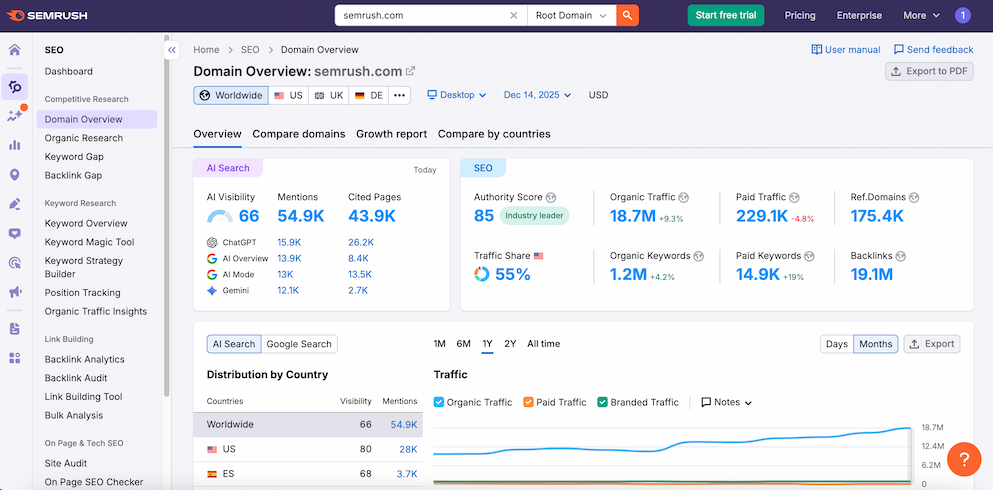
The Domain Overview provides a comprehensive snapshot of any website’s performance. You’ll see organic and paid traffic estimates, backlink metrics, top-performing pages, and competitive positioning. This bird’s-eye view helps you quickly assess whether a competitor poses a real threat or just appears prominent in search results.
Traffic analytics go deeper, showing traffic trends over time, traffic sources, and geographic distribution. While these estimates aren’t perfectly precise, they provide reliable directional insights for strategic planning.
Organic Research and Competitor Tracking
Organic Research allows you to analyze competitor keyword rankings and identify their strongest content. You can see which keywords drive the most traffic to competitor sites, helping you understand their content strategy and find opportunities they’ve missed.
The competitor tracking feature monitors changes in competitor performance over time. Set up alerts to know when rivals launch new content or experience significant ranking shifts.
Market Explorer
Market Explorer helps you understand broader industry trends and identify key players within your niche. This tool reveals market share estimates, audience demographics, and traffic distribution across competitor sites. For strategic planning sessions with clients, this data provides context that individual keyword metrics can’t capture.
Content Marketing Tools
SEO Content Template
This feature generates optimization recommendations based on top-ranking pages for your target keyword. You’ll receive suggestions for semantically related keywords, content length benchmarks, and potential backlink sources. The template acts as a brief for content creators, ensuring they have the right guidance before writing begins.
SEO Writing Assistant
The Writing Assistant provides real-time feedback as you create content. It analyzes readability, SEO optimization, tone consistency, and originality. Integration with Google Docs and WordPress makes it accessible where content teams actually work.
From my experience managing business content operations, real-time feedback prevents costly revisions later. Writers can adjust their approach before completing full drafts.
Content Audit and Topic Research
The Content Audit evaluates existing content for optimization opportunities. It identifies pages with declining traffic, outdated information, or thin content that needs expansion. This feature helps prioritize refresh efforts where they’ll deliver the biggest impact.
Topic Research suggests content ideas based on trending searches and audience interests. Rather than brainstorming in a vacuum, you can validate topic selection with data on search demand and competitive landscape.
Rank Tracking and Position Monitoring
Semrush tracks keyword positions daily across multiple locations and devices. The Position Tracking tool monitors visibility in various SERP features including featured snippets, local packs, and knowledge panels. This comprehensive view shows how algorithm updates and optimization efforts affect your overall search presence.
For managing client expectations, detailed rank tracking tools become essential. You need granular data to explain performance fluctuations and justify ongoing optimization work.
The platform also estimates visibility scores and traffic potential for tracked keywords, helping you quantify the business impact of ranking improvements.
Backlink Analysis Tools
Backlink Analytics
This tool provides comprehensive insights into any website’s backlink profile. You’ll see total backlink counts, referring domains, authority scores, and anchor text distribution. The competitive backlink analysis reveals where competitors earn links, helping you identify outreach opportunities and partnership possibilities.
Backlink Audit
The Backlink Audit identifies potentially harmful links that could trigger manual penalties or algorithmic demotions. Semrush assigns toxicity scores based on various spam indicators, making it easier to prioritize disavowal efforts.
Regular backlink audits have saved several of my consulting clients from penalty disasters. Proactive monitoring prevents problems before they impact rankings.
Link Building Tool
Semrush streamlines outreach by suggesting potential backlink opportunities based on your niche and competitors’ link profiles. The tool helps manage outreach campaigns, track responses, and monitor acquisition success rates. While relationship-building remains fundamentally human work, these organizational features prevent promising opportunities from slipping through the cracks.
Technical SEO Features
Site Audit
The Site Audit crawls your website to identify technical issues affecting performance and rankings. It flags broken links, duplicate content, slow-loading pages, mobile usability problems, and hundreds of other potential issues. Reports prioritize problems by severity, helping teams focus on fixes that matter most.
On-Page SEO Checker
This feature analyzes individual pages for optimization opportunities. It compares your pages against top-ranking competitors, suggesting improvements to title tags, meta descriptions, content structure, and internal linking. The recommendations are specific and actionable rather than generic best practices.
AI-Powered Features in 2026
Semrush has integrated artificial intelligence across several tools to enhance efficiency. The platform now offers AI-powered content suggestions, automated reporting insights, and predictive analytics for ranking opportunities. These features help marketers work faster without sacrificing strategic thinking.
The AI recommendations improve as the system learns from your optimization patterns and performance outcomes. This personalization makes the tool increasingly valuable over time.
Additional Tools and Integrations
Beyond core SEO features, Semrush includes social media marketing tools, PPC research capabilities, and marketplace intelligence. Integrations with Google Analytics, Google Search Console, and major CMS platforms ensure data flows smoothly across your marketing stack.
Semrush Pricing Plans 2026
Pro Plan
Designed for freelancers and small teams, the Pro plan provides essential features at the entry level. You get access to keyword research, site audits, position tracking, and basic reporting. This plan suits individual consultants or small businesses just beginning serious SEO work.
Guru Plan
The Guru plan targets growing businesses and agencies with more extensive needs. It includes Content Marketing Platform access, historical data, and extended limits on projects and reports. Most of my mid-sized agency clients operate on this tier, finding it offers the right balance of features and cost.
Business Plan
Built for larger organizations, the Business plan provides comprehensive tools with higher limits on tracked keywords, projects, and reports. It includes API access, extended user seats, and priority support. Enterprises managing multiple brands or large-scale campaigns typically require this level.
Understanding Usage Limits and Add-Ons
Each plan caps the number of keywords tracked, reports generated, and projects managed. Additional features like extra user accounts, increased report limits, or API access come at extra cost. These add-ons can significantly increase your total investment, so understanding your actual usage needs before subscribing helps avoid surprise expenses.
Is Semrush Reliable and Accurate?
Data Accuracy and Sources
Semrush combines proprietary crawling data with integrations from platforms like Google to ensure accuracy. The keyword database updates regularly to reflect current search trends. However, traffic estimates remain approximations rather than exact figures.
In my experience comparing Semrush data against actual Google Analytics numbers, the estimates typically fall within a reasonable range for directional planning. They’re reliable enough for competitive intelligence and strategy development, even if not perfect for precise forecasting.
Database Size and Coverage
With a massive database covering billions of keywords across multiple countries, Semrush provides comprehensive global coverage. This extensive reach makes it suitable for international campaigns and multi-market strategies.
Limitations to Be Aware Of
Users should understand that plan limits on projects and user accounts can constrain larger teams. Traffic estimates, while useful, shouldn’t be treated as exact measurements. Some competitors offer more specialized features in specific areas like backlink analysis or keyword tracking.
Real User Reviews and Experiences
What Users Love About Semrush
Reading the Semrush reviews, it’s easy to notice that many users consistently praise the platform’s comprehensive feature set. They also highlight its ability to manage multiple aspects of digital marketing from one dashboard. The depth of competitive intelligence and keyword research capabilities earn particular appreciation. Many reviews highlight how Semrush helps them make data-driven decisions rather than relying on guesswork.
Common Complaints and Frustrations
The learning curve challenges newcomers who feel overwhelmed by the interface and feature breadth. Some users find the cost prohibitive, especially when factoring in necessary add-ons. Limited user accounts per plan frustrate teams wanting to share access across departments.
User Review Ratings Across Platforms
Semrush maintains strong ratings across major review platforms, reflecting general satisfaction with its capabilities. While some critical Semrush reviews point to specific limitations or pricing concerns, the overall sentiment skews positive from users who actively engage with the platform’s features.
Semrush vs Top Competitors
Semrush vs Ahrefs
Both platforms offer powerful SEO capabilities, but they emphasize different strengths. Ahrefs excels particularly in backlink analysis with a larger link index and more frequent updates. Semrush provides broader marketing features beyond pure SEO, including content marketing tools and PPC research.
For pure link building and backlink analysis work, Ahrefs often edges ahead. For comprehensive digital marketing campaigns spanning multiple channels, Semrush delivers more integrated functionality.
Semrush vs Moz Pro
Moz Pro presents a more beginner-friendly interface with gentler learning curves. Its Domain Authority metric has become an industry standard for quick site evaluation. However, Semrush offers deeper data insights, more extensive keyword coverage, and a broader tool variety for experienced marketers.
Beginners often start with Moz Pro, then graduate to Semrush as their needs become more sophisticated.
Semrush vs SE Ranking
SE Ranking delivers solid functionality at lower price points, making it attractive for budget-conscious marketers. The platform covers essential SEO needs adequately. Semrush justifies its higher cost through more comprehensive data, advanced features, and deeper competitive intelligence.
For small businesses with basic SEO needs, SE Ranking may suffice. For competitive industries requiring every possible advantage, Semrush’s additional capabilities prove worthwhile.
Semrush vs Surfer SEO
Semrush offers a comprehensive suite of tools for keyword research, site audits, and competitive analysis, making it ideal for holistic SEO strategies. Surfer SEO focuses on on-page optimization and content strategies, providing data-driven recommendations for improving content relevance and SERP rankings. Choose Semrush for broader SEO management and Surfer SEO for targeted content optimization. Surfer SEO excels in helping users easily write content (especially within WordPress) that aligns with current top-ranking pages, ensuring relevance and effectiveness.
Who Should (and Shouldn’t) Use Semrush
Best Use Cases for Semrush
Digital marketing professionals managing comprehensive campaigns benefit most from Semrush’s integrated approach. Agencies handling multiple clients appreciate the project organization and white-label reporting. In-house teams scaling content operations find the workflow integrations particularly valuable.
The platform excels for competitive industries where understanding rival strategies creates meaningful advantages. If your business depends on organic search visibility, Semrush provides the intelligence needed to compete effectively.
When Semrush Might Not Be the Right Fit
Small businesses with limited budgets or minimal SEO needs may find Semrush’s cost prohibitive relative to simpler alternatives. Complete beginners might feel overwhelmed and would benefit from starting with more basic Semrush competitors before advancing to comprehensive platforms.
If you only need rank tracking without broader SEO features, specialized rank tracking tools might serve you better at lower costs.
Alternatives to Consider
Budget-conscious marketers should evaluate some Semrush competitors like SE Ranking or Moz Pro for more affordable options. Those focused primarily on backlink analysis might prefer Ahrefs. Beginners could start with free tools like Google Search Console before investing in premium platforms.
Getting Started with Semrush
Free Trial and Testing Period
Semrush offers a free trial period, allowing you to explore features before committing to a paid subscription. This testing window provides valuable hands-on experience to determine whether the platform fits your workflow and meets your needs.
Take advantage of the trial to run audits on your site, research your key competitors, and explore the tools you’ll use most frequently.
Initial Setup Steps
How to Set Up Your Semrush Account:
- Create your account and select your subscription tier based on your needs
- Add your primary website as a project and input up to four competitor domains
- Connect Google Analytics and Google Search Console for enhanced data accuracy
- Configure your first Position Tracking campaign with target keywords
- Run an initial Site Audit to establish your technical SEO baseline
- Set up weekly or daily reports to monitor key metrics automatically
This setup establishes your foundation for ongoing optimization work. The initial configuration takes about 30 minutes but pays dividends through automated monitoring and reporting.
Essential Features to Master First
Focus initially on keyword research tools, site audits, and competitive analysis features. These core capabilities deliver immediate value and help you understand your current position relative to competitors. Master these fundamentals before exploring advanced features like link building or content optimization tools.
I recommend spending your first week running comparative analyses against top competitors. Understanding where you stand helps prioritize which tools will deliver the biggest impact for your specific situation.
Is Semrush Worth It? Final Verdict
Value for Money Assessment
Semrush delivers substantial value for marketers who actively use its comprehensive features. The platform consolidates multiple specialized tools into one integrated system, potentially reducing overall software costs while streamlining workflows. For serious digital marketers and agencies, the ROI typically justifies the investment through improved rankings, increased traffic, and more efficient operations.
When the Investment Makes Sense
The investment makes sense for businesses where organic search drives meaningful revenue and competitive intelligence creates strategic advantages. Companies scaling their content operations, agencies managing multiple clients, and in-house teams optimizing enterprise sites benefit most from Semrush’s depth.
If SEO represents a core marketing channel rather than a peripheral activity, Semrush provides the tools needed to compete effectively in 2026’s increasingly complex search landscape.
Bottom Line Recommendation
Semrush remains one of the most comprehensive and reliable SEO platforms available today. While the learning curve and cost require commitment, the depth of insights and integrated features justify the investment for serious marketers. The platform continues evolving with new AI-powered capabilities and expanded data coverage, ensuring it stays relevant as search marketing evolves.
For digital marketers seeking a powerful all-in-one solution covering SEO, content marketing, and competitive intelligence, Semrush delivers exceptional value. Just ensure your team has the expertise to leverage its capabilities fully, as the platform rewards users who invest time learning its features.
Frequently Asked Questions
What is Semrush, and what does it do?
Semrush is a comprehensive digital marketing platform that provides tools for SEO, PPC, content marketing, and competitive research. It helps marketers research keywords, audit websites, track rankings, analyze backlinks, and develop data-driven marketing strategies.
Is Semrush worth the cost?
Semrush is worth the investment for businesses and professionals who actively use its features for SEO and digital marketing. The platform’s comprehensive data and integrated tools can improve rankings, drive traffic, and streamline workflows, typically delivering positive ROI for serious marketers.
How accurate is Semrush data?
Semrush data is generally reliable for strategic planning and competitive analysis. While traffic estimates are approximations rather than exact figures, they typically fall within reasonable ranges. The platform combines proprietary data with integrations from sources like Google to enhance accuracy.
Is Semrush good for beginners?
Semrush offers powerful capabilities but has a steeper learning curve than beginner-focused alternatives. While newcomers can use the platform, those completely new to SEO might benefit from starting with simpler tools before advancing to Semrush’s comprehensive feature set.
What’s the difference between Semrush Pro, Guru, and Business plans?
The Pro plan suits freelancers and small teams with basic needs. The Guru plan adds Content Marketing Platform access and extended limits for growing businesses. The Business plan provides enterprise-level features, API access, and higher limits for large organizations managing multiple campaigns.
How does Semrush compare to Ahrefs?
Both tools offer powerful SEO capabilities. Ahrefs excels in backlink analysis with a larger link index, while Semrush provides broader marketing features including content tools and PPC research. Semrush offers better all-in-one functionality, while Ahrefs specializes more narrowly in link analysis.
Can I try Semrush before buying?
Yes, Semrush offers a free trial period allowing you to explore its features before committing to a paid subscription. This trial provides hands-on experience to determine whether the platform meets your needs and fits your workflow.
What are the main limitations of Semrush?
Key limitations include usage caps on projects, keywords tracked, and reports per plan tier. The platform also restricts user accounts per subscription and charges extra for add-ons. Traffic estimates, while useful, aren’t perfectly precise measurements.
Did you find it valuable? Please rate to support our work!
Discover more from Best Software & Apps — Tested & Reviewed
Subscribe to get the latest posts sent to your email.